What is a Philosophical Essay?
A philosophical essay is the most refined field of inquiry that liberates concepts from blindly accepted patterns, generates original ideas by confronting opposing views, and expands the limits of our minds so that we can think independently. It differs from the literary essay. In literary essays, clarity is often sacrificed for surprise, and aesthetic concern may produce obscurity. A philosophical essay resembles scientific writing more closely. Its primary aims are to express ideas clearly, speak concisely, and maintain an honest dialectic. While a literary essay seeks to impress the reader, a philosophical essay seeks to analyze different perspectives on a subject. In other words, it serves not an individual, but the pursuit of understanding and resolution regarding the issue itself.
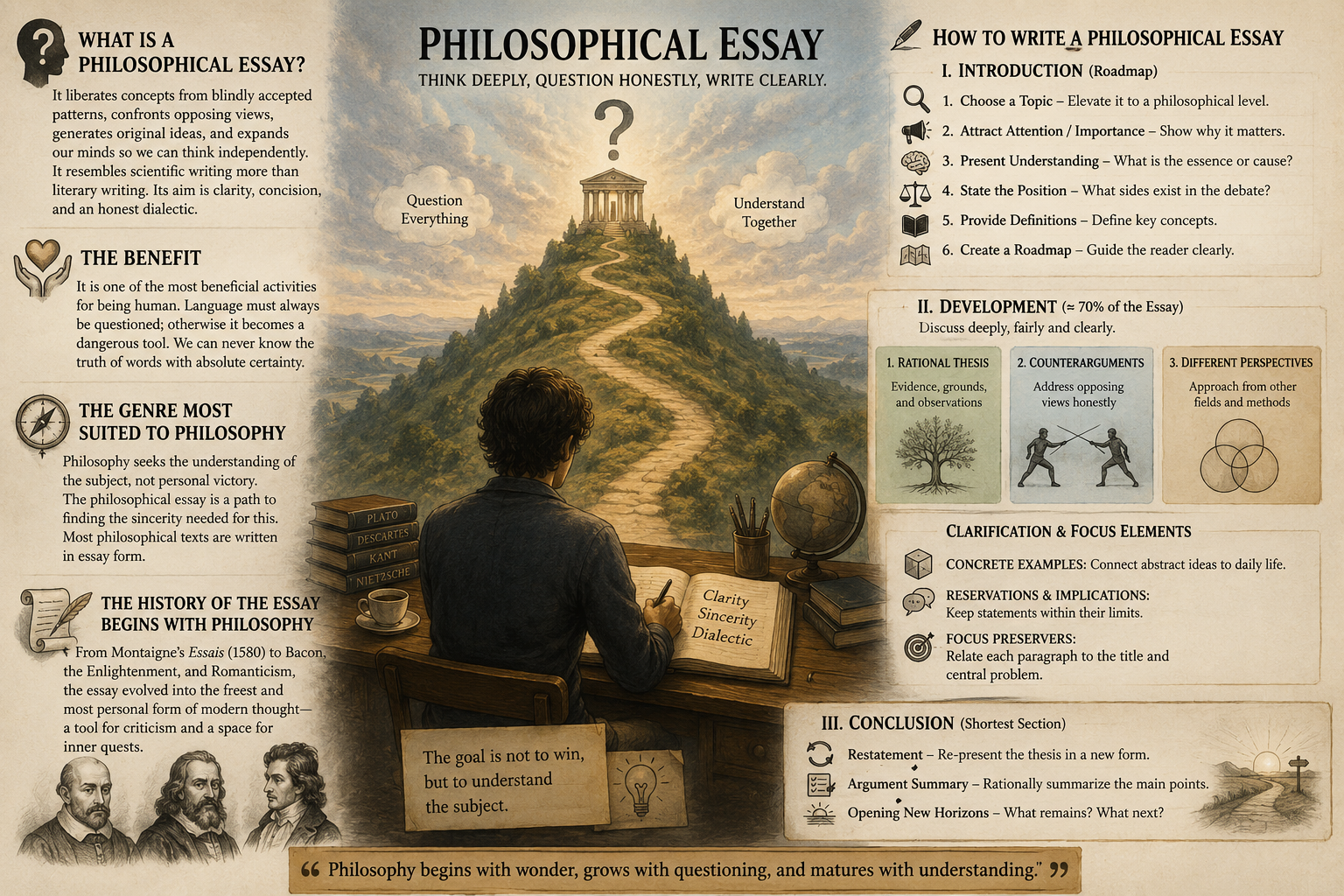
The Benefit of Philosophical Essays
Writing philosophical essays is one of the most beneficial intellectual activities for human beings. Humans operate through concepts. Because language is inherently ambiguous, polysemous, and open-ended, concepts must constantly be questioned. When language is not examined—when its accuracy is not tested—it becomes a dangerous tool that functions incorrectly. Using words without questioning them, without investing effort into language, is a negligence that carries consequences. The consequence is mistaking falsehood for truth. We cannot claim the truth of anything without examination, much less the truth of words, which are merely assumed sound-symbols whose meanings can never be known with absolute certainty.
The Genre Most Suited to Philosophy
To philosophize—that is, to strive not for personal victory but for the understanding and success of the subject itself—requires sincerity. Philosophy cannot be practiced with those who only seek to win. Therefore, the philosophical essay is also a means of discovering within oneself the sincerity necessary for philosophy. Most philosophical texts are written in essay form. Since philosophy is not empirical, sensory, or measurement-based, it naturally takes refuge in such an analytical genre. The genre that most closely aligns with philosophy’s condition of “being on the way” is the philosophical essay.

The History of the Essay Begins with Philosophy
The essay genre began its life as the philosophical essay; later, literary essays became dominant and shaped the common understanding of the form. Beginning with Michel de Montaigne’s Essais in 1580, the essay absorbed the analytical rigor of Francis Bacon, the critical spirit of the Enlightenment, and the subjective voice of Romanticism, eventually becoming the freest and most personal form of modern thought. During the Enlightenment, this flexible genre became a tool of social criticism; in the modern world, it evolved into a foundational literary space that conveys the individual’s inner quests and intellectual crises.
How to Write a Philosophical Essay
Introduction
- Choose a Topic:
Anything can become the subject of a philosophical essay. However, it must be elevated from a merely technical or everyday level to a philosophical one. An essay about cars becomes philosophical only when it touches upon concepts such as “transportation”; an essay about food when it addresses “nutrition”; and a text about government when it discusses “the state,” “politics,” or “power.” - Attract Attention or Emphasize Importance:
Either begin with an attention-grabbing introduction or explain why the topic matters. Introductions are important in every form of writing because readers are often prejudiced or impatient. - Present Understanding:
What is your understanding of the subject? If you are analyzing a quotation, explain what you understand from it. If discussing a problem, explain its cause or significance. - State the Position:
Do you hold a position? If not, briefly outline the existing positions in the debate. What sides exist within the statement or problem? - Provide Definitions:
If there is no explicit position, there must still be definitions—and definitions are always necessary. Define important terms. This is not merely informative; it also demonstrates your understanding of the terms you will use throughout the essay. Definitions improve clarity and comprehension. - Create a Roadmap:
The introduction is a roadmap. Unlike literary essays, everything essential is stated in the introduction, while the development section elaborates on it. The introduction should welcome a stranger and help the reader understand you as clearly as possible.
Development
The development section constitutes approximately 70% of the essay. After introducing the main ideas, this section is used to examine opposing views, counterarguments, and alternative perspectives.
In a philosophical essay, merely presenting evidence is insufficient. What makes the essay philosophical is the inclusion of counterarguments and differing perspectives. In a successful philosophical essay, there must also be qualifiers, reservations, observations, and logical connections that link evidence to claims.
In conceptual discussions, it is difficult for people to truly understand one another. They may pretend to understand or think they understand, but because abstract concepts lack tangible, visible forms, disagreement is inevitable. Therefore, we must provide enough clarity to answer every possible question the reader may have.
Each paragraph in the development section should possess unity. Claims and counterclaims may appear either within the same paragraph or in separate ones.
The essay form possesses a freedom that can lead to a loss of focus. Therefore, regardless of what is being discussed, the connection to the essay’s title or key concept introduced at the beginning must always be maintained. One should avoid discussions that do not contribute to the central issue. Repeating key terms frequently, emphasizing how each point contributes to the discussion, and highlighting the relevance of each paragraph to the main problem help preserve focus.
Counterarguments, perspectives, and reservations are distinct forms of argumentation:
- A counterargument directly opposes your claim.
- A perspective approaches the issue from another field or method.
- Reservations and implications are indispensable in abstract discussions.
Not everything we say reaches everyone in the same way. Therefore, we must constantly clarify our scope and limitations:
“By knowledge, we mean scientific knowledge; we exclude the changing trends of the humanities.”
“Although I spoke of the ideal state, the state itself may not be ideal; I am speaking from within the system.”
Such clarifications prevent our words from exceeding their intended scope or being misunderstood.
Concrete examples, connections to daily life, and supplementary support should be preferred because they clarify abstract discussions. Comparisons, statistics, and case studies are also useful for maintaining attention and focus. At the end of the development section, weighing and comparing different views is generally beneficial.
Conclusion
The conclusion is the shortest section of the philosophical essay. While concluding, we may restate our thesis in a new form, briefly summarize the arguments, and illuminate possible future readings or discussions. We may also emphasize the essay’s scope, point out what remained incomplete, and indicate what else should be discussed.
STRUCTURE & FOCUS
TITLE & FOCUS

┌────────────────────────────────────────────────┐
│ INTRODUCTION SECTION                          │
│ [Roadmap]                                     │
├────────────────────────────────────────────────┤
│ ▼ ATTENTION & IMPORTANCE                      │
│ The introduction should be striking and       │
│ emphasize the importance of the topic.        │
│                                                │
│ ▼ PERSONAL UNDERSTANDING                      │
│ The essence/cause of the problem or quotation │
│                                                │
│ ▼ POSITION & SIDES                            │
│ The sides and tendencies within the debate    │
│                                                │
│ ▼ DEFINITIONS                                 │
│ Drawing the boundaries of key concepts        │
└────────────────────────────────────────────────┘
│
▼
┌────────────────────────────────────────────────┐
│ DEVELOPMENT SECTION                           │
│ [70% of the Text - Toulmin-Based]             │
├────────────────────────────────────────────────┤
│ 1. RATIONAL THESIS                            │
│ Evidence, grounds, and observations           │
│                                                │
│ 2. COUNTERARGUMENTS                           │
│ Honest treatment of opposing views            │
│                                                │
│ 3. DIFFERENT PERSPECTIVES                     │
│ Solutions from different methods and fields   │
├────────────────────────────────────────────────┤
│ CLARIFICATION & FOCUS ELEMENTS                │
├────────────────────────────────────────────────┤
│ * CONCRETE EXAMPLES:                          │
│ Connecting abstract discussion to daily life  │
│                                                │
│ * RESERVATIONS & IMPLICATIONS:                │
│ Preventing statements from exceeding limits   │
│                                                │
│ * FOCUS PRESERVERS:                           │
│ Emphasizing connections to the title and      │
│ central problem at paragraph endings          │
└────────────────────────────────────────────────┘
│
▼
┌────────────────────────────────────────────────┐
│ CONCLUSION SECTION                            │
│ [Shortest Section]                            │
├────────────────────────────────────────────────┤
│ ▼ RESTATEMENT                                 │
│ Re-presenting the thesis in a new form        │
│                                                │
│ ▼ ARGUMENT SUMMARY                            │
│ Rational summary of the main body             │
│                                                │
│ ▼ OPENING NEW HORIZONS                        │
│ Remaining questions and future discussions    │
└────────────────────────────────────────────────┘

